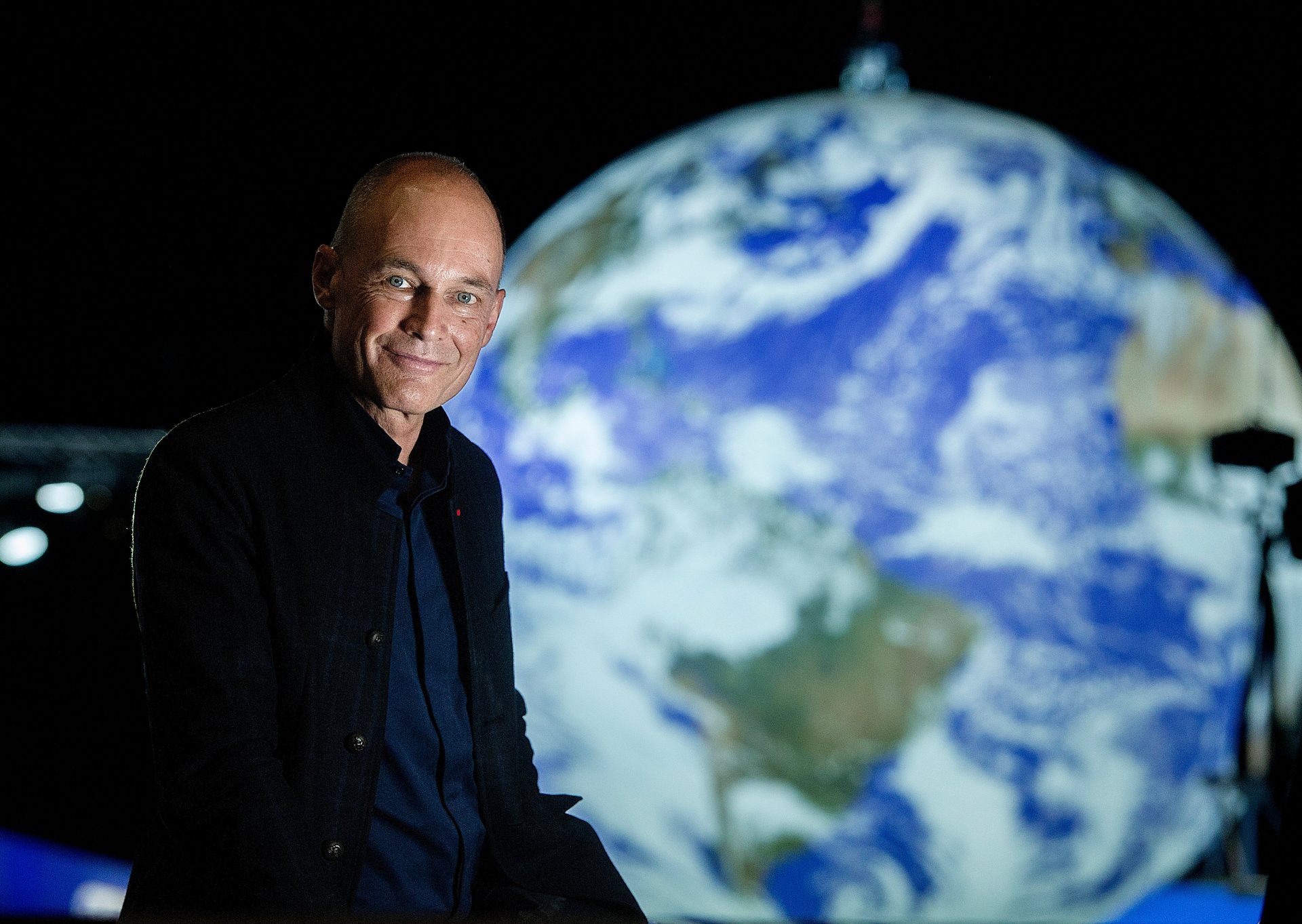

The explorer and founder of the Solar Impulse Foundation believes the future won’t be won through sacrifice — but through profitability, modernisation, and a willingness to embrace the unknown.
For Bertrand Piccard, the problem is no longer technology.
It’s mindset.
“When you speak about decarbonisation,” he says, “everybody is afraid. They think it’s a handicap for the economy. But when you speak about modernisation, everybody can agree.”
“Being an innovator is a decision you take for your life. It’s the decision to face the unknown, to swim in doubt, to face criticism — and maybe succeed.”
That distinction sits at the centre of Climate Impulse — Piccard’s latest aviation mission aiming to fly a hydrogen-powered aircraft around the world by 2029. After years existing exclusively within the digital sphere, the aircraft is now physically taking shape: wings nearly complete, fuselage assembled, hydrogen pods under construction.
For Piccard, the shift from concept to reality matters deeply.
“Now we can show something, touch something,” he says. “It finally feels real.”
The aircraft itself is unconventional: a tiny central fuselage suspended between enormous wings and giant hydrogen storage pods. But unconventional thinking has defined much of Piccard’s career — from pioneering balloon flights to Solar Impulse’s historic round-the-world solar journey.
The deeper ambition behind Climate Impulse, though, extends far beyond aviation.
Piccard sees the project as part of a much larger effort to reframe sustainability itself — away from sacrifice and toward opportunity.
It’s about modernising the world
At the core of Piccard’s philosophy is a blunt assessment: modern systems are astonishingly inefficient.
“We are wasting three quarters of the energy produced,” he says. “A big part of the water, food, and natural resources are simply wasted.”
For him, the climate crisis is not only an environmental failure, but a design failure — the result of outdated infrastructure, obsolete technologies, and industrial inertia inherited from the oil era.
His language repeatedly returns not to “saving the planet,” but to upgrading systems.
“It’s not only about decarbonising the world,” he says. “It’s about modernising the world.”
That means electrification, smart grids, insulated buildings, heat pumps, LEDs, renewable energy systems, and industrial processes designed around efficiency rather than waste.
The argument, however, is fundamentally economic.
Piccard insists sustainability succeeds only when it becomes financially irresistible.
“You don’t need to be a green activist,” he says. “You prove with business cases how industry and finance can become more profitable.”
In that framing, decarbonisation becomes the logical consequence of modernisation rather than a moral burden.
Sustainability has a branding problem
Piccard believes one of the greatest barriers to climate innovation is not technology — but perception.
For decades, sustainability has been framed as expensive, restrictive, and sacrificial. Industry, meanwhile, has been associated with profitability and growth.
Piccard believes that binary is now obsolete.
“Far too often I hear ecology is by nature expensive, boring and sacrificial,” he says. “And industry by nature is profitable but dirty. No. Now we show that ecology can be profitable and industry can be clean.”
That philosophy has shaped the work of the Solar Impulse Foundation, which has now identified more than 1,650 profitable clean technologies capable of reducing emissions while strengthening economic performance.
The challenge now, Piccard says, is scale.
Small and medium-sized businesses often want to modernise but lack access to upfront financing. Through partnerships with institutions including the European Investment Bank, the foundation has explored models allowing businesses to install innovative solutions with no initial payment and repay investment through future energy savings.
“The solutions exist,” Piccard says. “People know they are profitable.”
What’s needed now is momentum.
The future always looks impossible before it becomes inevitable
Despite the optimism surrounding Climate Impulse, Piccard avoids speaking with certainty about the mission’s outcome.
“It’s more humility than confidence,” he says. “I cannot say we will do it. I just say we will try.”
That uncertainty, he argues, is inseparable from innovation itself.
“A pioneer is someone who is not afraid of failing.”
“Being an innovator is a decision you take for your life,” he says. “It’s the decision to face the unknown, to swim in doubt, to face criticism — and maybe succeed.”
Piccard speaks about pioneers with almost philosophical reverence — not simply as inventors, but as people willing to move before outcomes are guaranteed.
“A pioneer is someone who is not afraid of failing.”
Hydrogen aviation, he admits, still faces scepticism. Critics point to the scale of infrastructure changes required — new systems, new supply chains, new airports.
But Piccard sees historical precedent everywhere.
Just over a century ago, society transitioned from horses to automobiles. The first mobile phones were prohibitively expensive and the size of suitcases. Solar energy, once dismissed as unrealistic, is now among the cheapest forms of power in the world.
“The future always looks impossible before it becomes inevitable,” he suggests.
For Piccard, hydrogen simply represents the next transition waiting to happen.
Hope is the result of action
Perhaps the most striking aspect of Piccard’s worldview is his resistance to climate fatalism.
He worries about a generation increasingly convinced the future is already lost.
“There are too many people who believe there are no solutions and no future,” he says.
His answer is not optimism for optimism’s sake, but action.
“If we have solutions, we can act. And acting can bring hope.”
Then comes the line that feels most emblematic of his entire philosophy:
“Hope is only the result of actions undertaken thanks to solutions. Otherwise, it’s just a naive utopia.”
For Piccard, the future is not something predicted.
It is something built.
__
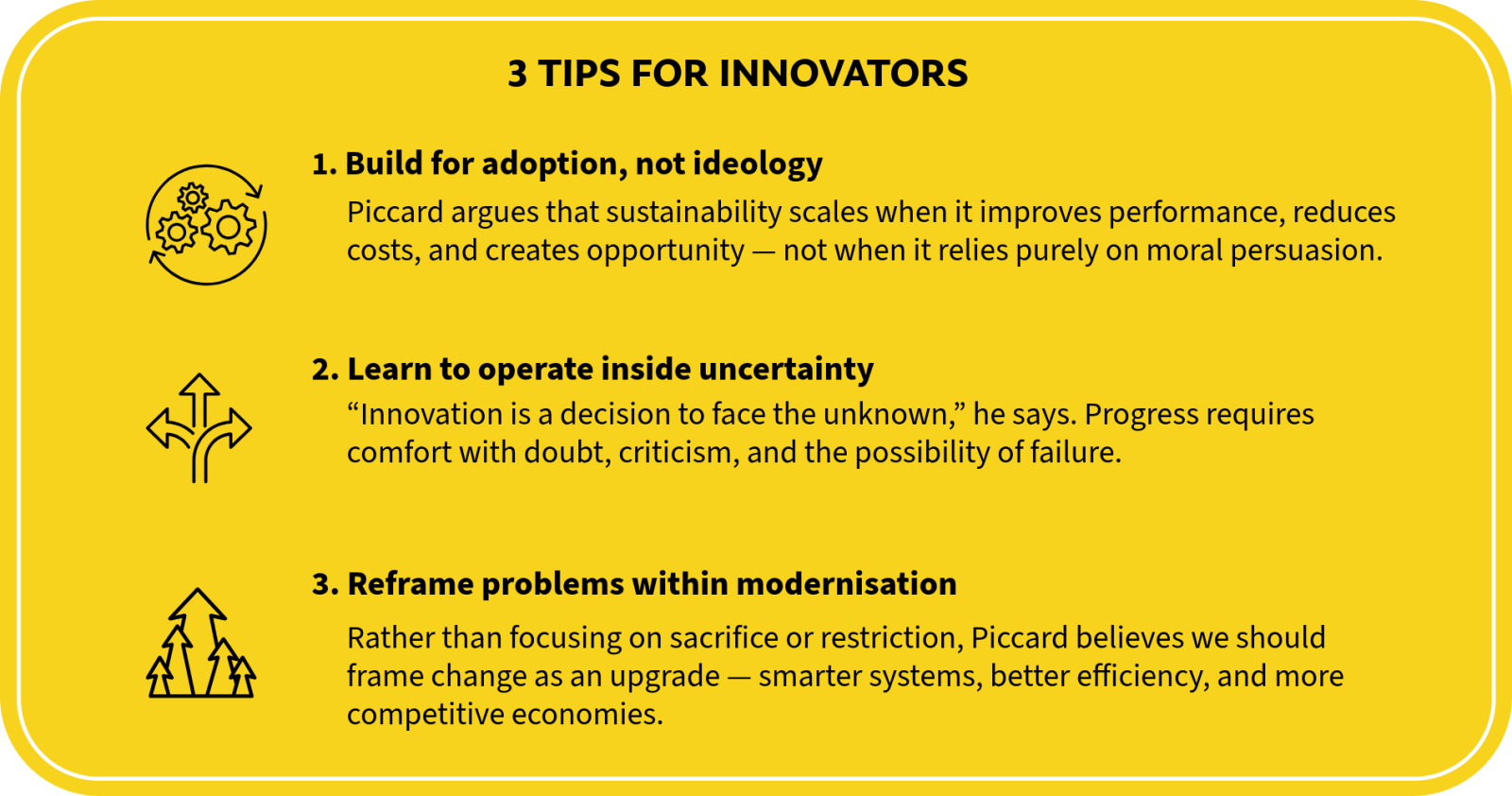
PICCARD’S TIPS FOR INNOVATORS
__
Sign up for our newsletter to get the latest innovation news and more sent to your inbox.