
Meet two emerging designers exploring how empathy and hands-on experimentation are reshaping technology.
━━━━ ● ━━━━
Innovation often begins not with a breakthrough technology, but with a better understanding of people.
This summer, two designers from the Innovation Design Engineering (IDE) programme—a joint MA/MSc offered by the Royal College of Art and Imperial College London—are challenging assumptions about how we design products for the real world.
Their work will be showcased at the Royal College of Art School of Design EXPO, taking place 16–19 July 2026 in London, where graduating students will present projects spanning healthcare, manufacturing, sustainability and emerging technologies.
From making digital design more intuitive to breaking down barriers in men’s healthcare, Calvin Calica and Yuzhen Fu share the thinking behind their work through three simple questions.
████████████
Calvin Calica
Reimagining the Human Touch in Digital Design
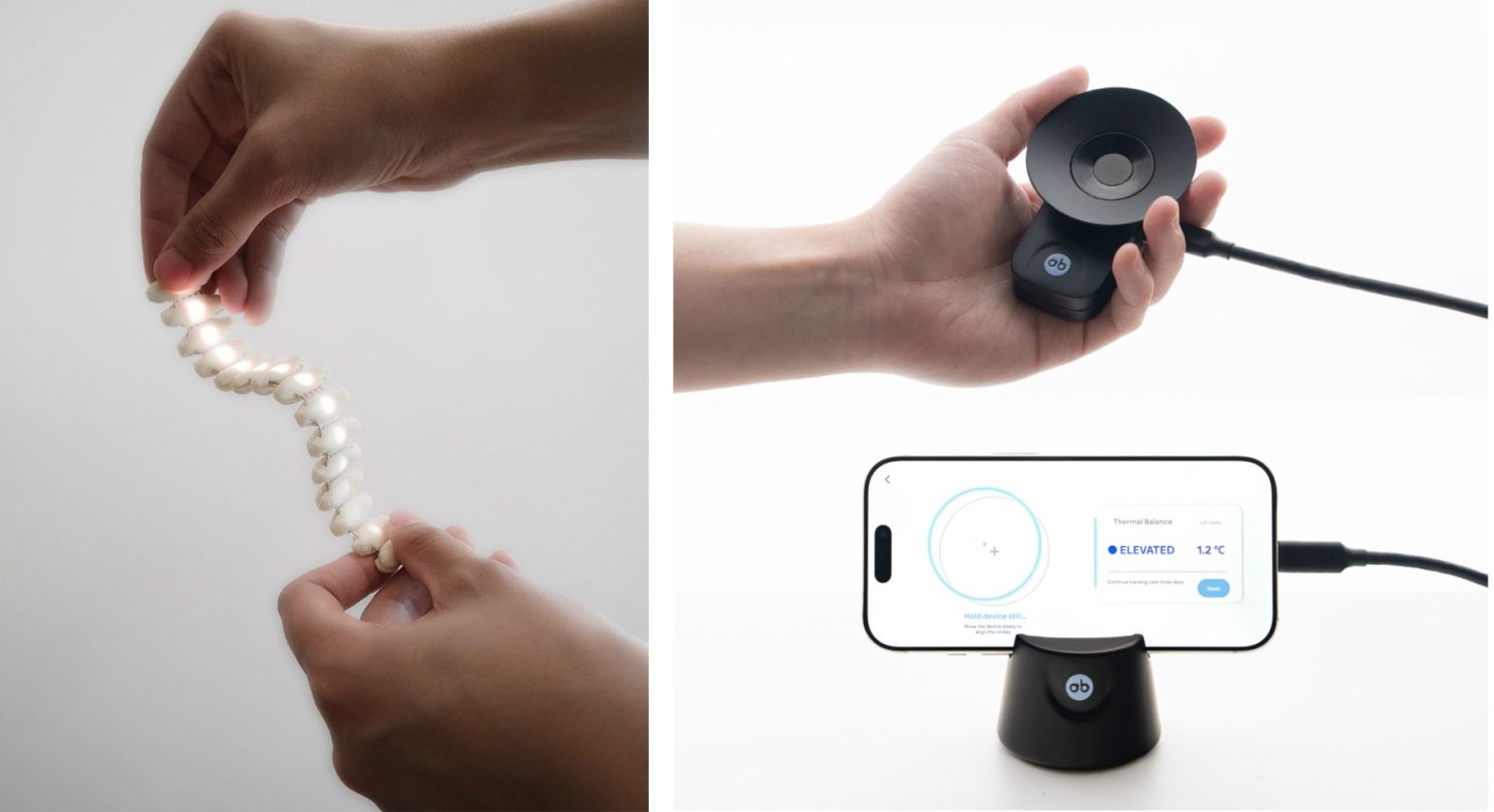
Design: COIL explores how touch and gesture can transform digital design, helping makers create 3D objects as naturally as they work with their hands.
What made you stop and think?
“I kept watching skilled makers lose something the moment they sat down at a computer. One ceramicist said it perfectly: ‘I don’t know if this distance should be 15 or 15.5 centimetres, but if I could feel it, I could tell you.’ She’d spent years learning to judge form with her hands, yet digital tools couldn’t capture that instinct. I realised design software had been built for precision—not sensation.”
What did you see differently?
“I stopped asking how to make CAD easier and started asking what if it began with the hand instead of the screen? That led to a soft, bendable tool that lets makers shape digital geometry through touch rather than numbers. The breakthrough wasn’t simplifying the software—it was changing the conversation between designer and technology.”
What difference do you hope it makes?
“I’d love tactile input to become a natural part of digital design rather than a novelty. Success would mean makers reaching for tools they can bend, squeeze and shape just as naturally as they reach for a mouse today.”
⬤
Calvin Calica is an industrial designer and composer completing the Innovation Design Engineering MA/MSc at the Royal College of Art and Imperial College London. His work explores how touch, sound and making can create more intuitive human experiences—from accessible game controllers to tangible tools for digital design.
████████████
Yuzhen Fu
Designing Dignity into Men’s Health
Design: OBRE is designed to remove the barriers of stigma and embarrassment by enabling private, at-home testicular health screening using non-invasive thermography and Edge AI.
What made you stop and think?
“As I became more responsible for my own health, I noticed something surprising. We can monitor sleep, heart rate and oxygen levels at home, yet testicular health remains a blind spot. The technology exists in hospitals, but embarrassment prevents many men from seeking help early.”
What did you see differently?
“I realised the real challenge wasn’t improving diagnosis—it was reducing the barrier to taking the first step. By combining non-invasive thermography with on-device AI, we could create a private screening tool that encourages earlier action while protecting personal privacy.”
What difference do you hope it makes?
“I hope we can normalise conversations around male reproductive health in the same way public awareness campaigns transformed attitudes towards breast health. If people feel more comfortable checking their health early, we’ll have created something that extends well beyond technology.”
⬤
Yuzhen Fu is an innovation designer completing the Innovation Design Engineering MA/MSc at the Royal College of Art and Imperial College London. Specialising in healthcare technology and human-centred design, his work explores how innovation can reduce stigma and improve access to early diagnosis. His project, OBRE, is being developed in collaboration with clinical researchers to support real-world validation.
__
Sign up for our newsletter to get the latest innovation news and more sent to your inbox.