Build What Matters
AI Answers. You Decide: UNESCO puts critical thinking at the heart of AI education

As artificial intelligence reshapes how people access and interpret information, UNESCO has launched a new guide to help educators equip learners with the skills to question AI-generated content, recognise bias and make informed decisions.
What should students do when an AI chatbot delivers a convincing answer without a source? How do algorithms influence the information they encounter, and how can young people learn to distinguish reliable evidence from misleading content?
These questions are at the heart of AI Answers. You Decide, a new UNESCO guide designed to help educators strengthen media and information literacy (MIL) in the age of artificial intelligence.
OnePoint5Media and Innovators Magazine are members of UNESCO’s Global Media and Information Literacy (MIL) Alliance, a network bringing together organisations and individuals committed to advancing media and information literacy worldwide. The new guide speaks directly to this mission, as educators face growing challenges in helping learners navigate AI-generated content and an increasingly complex digital information landscape.

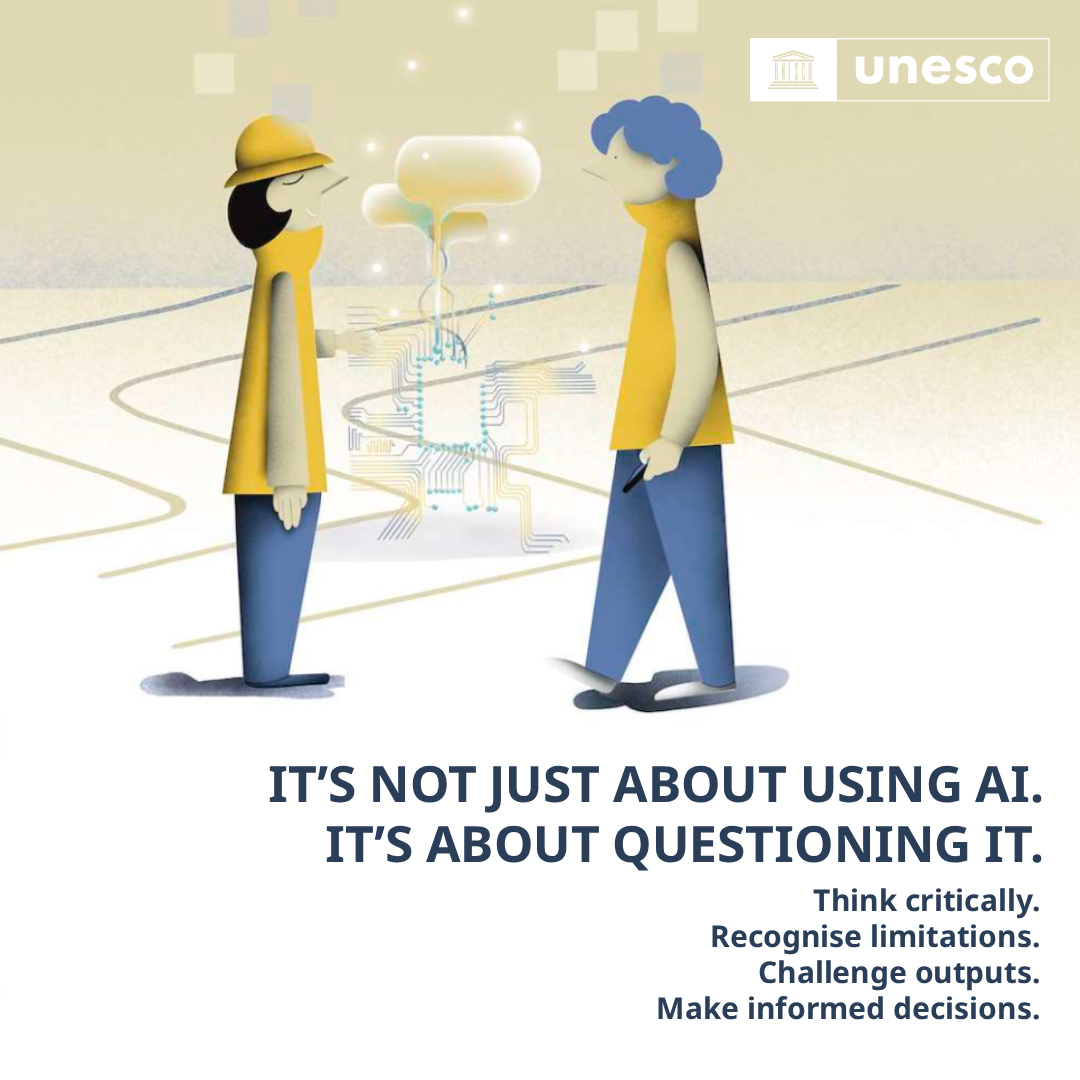
Launched during Global Media and Information Literacy Week 2026, the publication builds on UNESCO’s flagship Media and Information Literacy Curriculum, introduced in 2021 and since piloted and adapted in more than 40 countries.
Developed in response to growing demand from Member States, educational institutions and teachers, the guide provides a framework for exploring AI through the lens of media literacy, critical thinking and human rights. Its development brought together eight international experts, with additional specialists contributing through peer review to reflect diverse regional and educational perspectives.
Five ways to explore AI in the classroom
The guide is organised into five units, taking learners from their everyday digital experiences to wider questions about the future of society.
- AI in Our Pocket explores where learners encounter AI in daily life and what happens to the data they share.
- AI’s Roles in the Media Landscape examines how AI shapes news and other content, including what makes journalism trustworthy.
- AI, the Human Mind and Knowledge helps learners assess AI-generated claims, weigh evidence and develop independent judgement.
- AI, Power and Human Rights considers who benefits from AI, who risks being excluded and who is accountable for automated decisions.
- AI Futures Are Being Built Now encourages learners to think about the kind of AI future they want and how they can help shape it.
Together, the five units move beyond the mechanics of using AI tools. They encourage learners to question the technology, understand its wider implications and recognise the importance of human judgement.
Preparing learners for an AI-shaped future
As AI-generated information becomes increasingly common, the ability to assess sources, identify bias and verify claims is becoming an essential part of education.
UNESCO’s approach places media and information literacy at the centre of that challenge. Rather than treating AI as simply another digital tool, it encourages educators to explore its influence on knowledge, communication, power and society.
The guide is currently available in English, with French, Spanish and Arabic versions expected to follow.
UNESCO will also organise a series of webinars to introduce the resource and demonstrate how educators can bring its content into the classroom. Dates and registration details will be announced.
For educators, the message is clear: preparing learners for an AI-shaped future means giving them more than access to technology. It means helping them develop the confidence and critical thinking skills to question its answers, recognise its limitations and decide for themselves.
Explore the guide: AI Answers. You Decide – UNESCO.
Find out more about UNESCO’s Global Media and Information Literacy Alliance.
__
Sign up for our newsletter to get the latest innovation news and more sent to your inbox.